The Spotmatic is a series of 35mm SLR cameras produced in the 60s by Pentax. The original Spotmatic SP was introduced in 1964, and was one of the very first commercially available SLRs which offered TTL metering. Arriving in 1973, the Spotmatic F was the last of the line, and with more advanced features, it is generally considered to be the best of the lot.
Whenever you see Spotmatics mentioned in online discussions, it is usually because they are being touted as one of the best M42 camera bodies ever made. This is compounded by the fact that they are commonly found along with Takumar lenses, which also have a reputation for being extremely sharp, and superb performers. To this day, you can often still find a Takumar 50mm f1.4 attached to a cheaper Spotmatic camera body for far less than you may pay for the lens alone. That’s a top tip right there.
This blog is going to look at the Spotmatic F, and the earlier Spotmatic SP500. It is going to be fairly long and with a whole bunch of fascinating faux-technical explanations, so if you are easily bored, feel free to gloss over all the words and skip to the pictures at the end… of which there are many. The choice is yours.
The beginnings
As much as I love film cameras, I have always had a lot of trouble getting any kind of SLR or TLR to focus properly because my eyesight is pretty crap. It is so bad that I literally can’t tell the difference between something that is wildly out of focus, and something that is bang on. Unfortunately, while a corrective diopter eyepiece can solve this, finding one that is compatible with a specific model of vintage camera is almost impossible. In fact, the only one I’ve had much luck with on that front is the Hasselblad 500CM. For this reason, I tend to gravitate towards rangefinders, and have largely avoided SLRs.
However… after discovering the wonderful world of M42 manual focus lenses a few years ago, I increasingly felt like I was missing out, as I could only use them with my digital Sony A7. After shooting with the incredible Super Takumar 50mm f1.4 lens in particular, it seemed like the Spotmatic F would be a great camera to try some of my lens collection out with. I didn’t really fancy a (cheaper) chrome version though, and it felt tough to justify the cost of importing a black one from Japan if I couldn’t actually focus the thing properly. Eventually, I bit the bullet after having a trip to Tokyo cancelled thanks to COVID-19, and finding one which was relatively reasonably priced. I got impatient waiting for it to arrive though (ahem), and found a Spotmatic 500 cheap locally to try out in the meantime – so this blog is about my experience with both of them.

Feature Specs:
Spotmatic 500
The manual for the SP500 can be found here.
- Focus type: Single Lens Reflex (SLR).
- Mount: M42 thread mount.
- Shutter speeds: 1-1/500s*, including Bulb Mode.
- Shoe: None, but a slip-on cold-shoe accessory was available.
- Meter: Yes. ‘Stop down, match-needle’. Supports film speeds from ISO20-1600. You operate this by engaging the button at the side of the lens. f1.7??
- Battery: PX400 (PR41 or 392 with M42 adaptor)
- Self-Timer: No.
- Colour: Chrome (some ‘black’ models pop up on eBay, but all the ones I’ve seen have been re-paints, irrespective of what the seller claims)
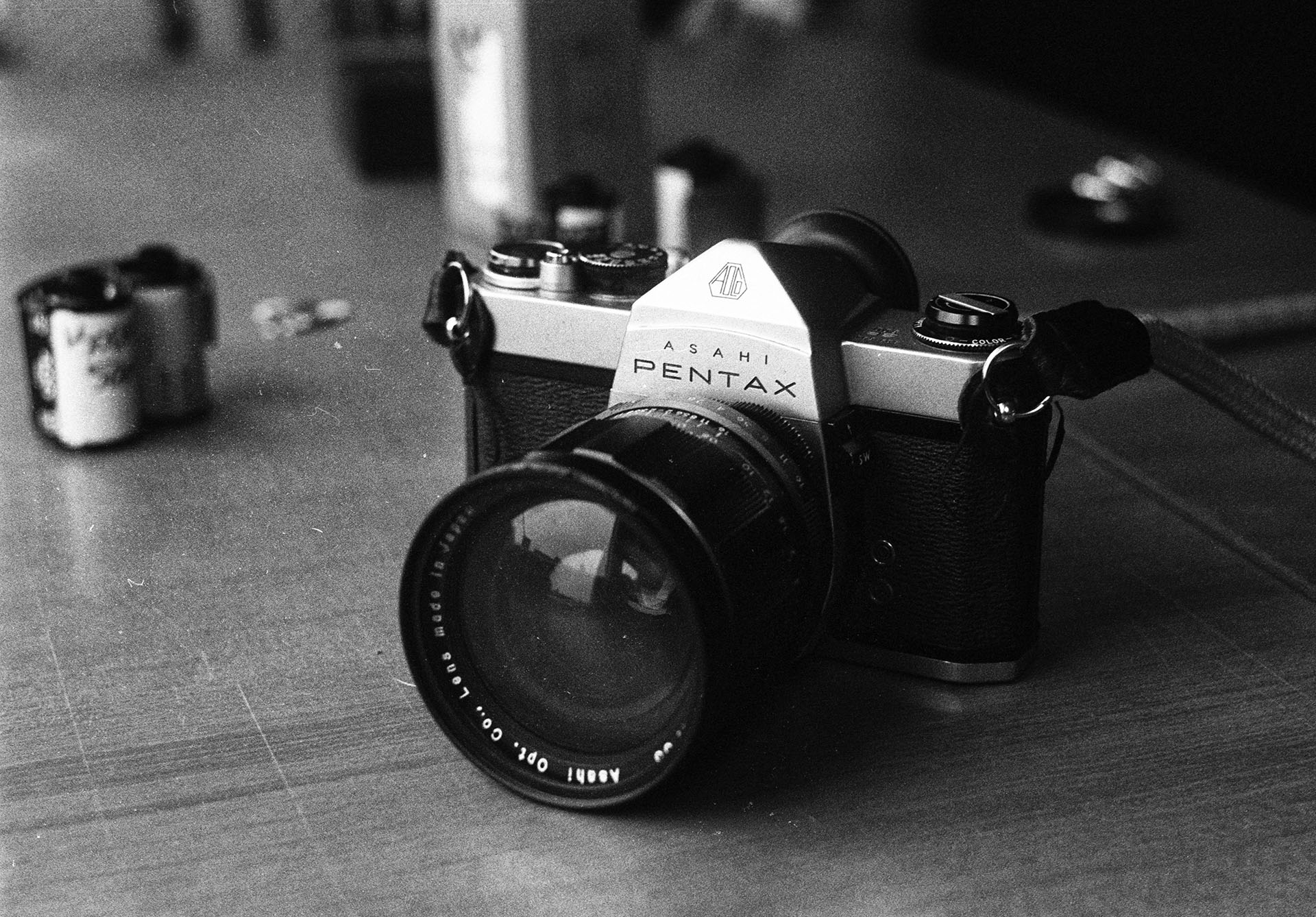
*The Spotmatic 500 was intended as the ‘budget’ camera of the series, with pared-down features like a reduced shutter speed, and lack of hotshoe. The 500 in the name referred to its supposed maximum shutter speed of 1/500s… but rather amusingly, Pentax simply re-used the shutter mechanism from the more expensive Spotmatic 1000 and changed out the dial – meaning that the 500 is still capable of shooting at 1/1000s by clicking past the 1/500s marking.
“Availability of batteries for the Spotmatic is better than other cameras of the era because the Asahi engineers built in a bridge circuit in the metering which makes it battery voltage independent. This means you can use the original 1.35 mercury PX400 battery, or a 1.5V silver-oxide replacement without problems.”
http://www.photoethnography.com/ClassicCameras/AsahiPentaxSP500.html
The WeinCell batteries are expensive – at about £5-6 a pop. The alternative is to get an H-B M42 adaptor at a one-off cost of around £6 which then allows you to then use the cheaper and more readily available PR41 1.45v Zinc Air, or the 392 1.55v silver oxide batteries. However, I think these adaptors are a bit of rip off. While other similar battery adaptors are metal (see the note on the Spotmatic F below), the H-B adaptor is literally just a flattened out rubber o-ring which the battery sits in. Given how average the meter is anyway, I wouldn’t recommend it.
Spotmatic F
- Focus type: Single Lens Reflex (SLR).
- Mount: M42 thread mount.
- Shutter speeds: 1-1/1000s, including Bulb Mode.
- Shoe: Yes. Cold-shoe included.
- Meter: …. Supports film speeds from ISO20-3200.
- Battery: PX625 (or PR44/675 with M9 adaptor)
- Self-Timer: Yes.
- Colour: Available in chrome or black, though the chrome appears to be more widely available.
Similar to the Spotmatic 500, the original 1.35v batteries the Spotmatic F was designed for are now discontinued – and the WeinCell direct replacements are expensive. However, you can again use an adaptor – this time the MR9 which then opens up the world of the Zinc Air PR44 f1.45v (aka 675) batteries. These are more common than the M42, and a bit cheaper. Reports online differ on the circuitry of the Spotmatic F and whether or not it has a bridge circuit or not, but irrespective of that – this method should produce reliable results. In all honesty though, I never bothered with the built-in meter, instead opting for an external Keks.
One notable thing the Spotmatic F has which the 500 does not is a shutter lock. If you want to avoid accidentally firing off a frame while the camera is cocked and in your bag/slung over your side/whatever, you can engage the lock so the shutter button won’t depress. Every camera should have this option as far as I’m concerned, but many don’t, so I was pleasantly surprised to find that the SPF does.

Metering
SLRs have a very particular problem. Since they use the same lens for both focussing, composing, and often metering… that lens is having to do a whole lot of legwork. If you are shooting at f8 or above, that means that you may need to first compose and focus at a wider aperture to ensure the viewfinder is bright enough, before stopping down to the desired aperture to ensure the picture is exposed properly.
This is clearly a bit of a pain, but becomes more complicated still when you factor in a meter. Meters need to know what the aperture is going to be at the time of the shot in order to give you an accurate interpretation – and a TTL (through the lens) meter can’t do that if you are composing with the lens wide open. To solve this, ‘stop down metering’ only engages the meter when you press a particular button. This system is found on the SP500, and it also has the added benefit of reducing the load on the battery. Of course, pressing a button to meter once composed is fiddly, and brings a whole bunch of problems… such as how you are meant to see a needle meter with a dull viewfinder at f16, or what strange contortions your hands will need to do to adjust the shutter speed/aperture while holding down an extra button, and not knocking off the focus.
The solution to these quandaries is full aperture metering. This allows you to compose and focus wide open – with the lens stopping down to the correct aperture at the last moment. Of course, the meter still needs to know what the aperture is, since it can’t just read the light coming through the lens in the same way. To communicate the aperture, lenses were then produced which had an extra tab, lever, pin, or chip – which then of course gets into the muddy world of different manufacturer standards.
The Spotmatic F has full aperture metering which means it is simpler to use, but also to meter with – so long as you have an M42 lens that supports the feature. The Super Takumars are the most notable Pentax lenses in this bracket, but there are lots of others. The (perhaps slightly confusing to modern ears) ‘Auto’ tag on older manual focus lenses usually refers to this. You can still use regular M42 lenses of course – they just won’t meter in the same way.
The Diopter Solution
I knew that finding a vintage Pentax diopter suitable for the eyepiece of the Spotmatic in my prescription would essentially be impossible, so I had to try and figure out an alternative solution. As I mentioned, this was the main reason I had largely avoided film SLRs up until this point. There were tales of enterprising folks cutting up reading glasses to fit the viewfinder window, but I don’t have a great track record with powered cutting tools, and it wasn’t easy to source the prescription I would need anyway – so this was not an option I was keen to pursue.
At first I decided to order a Pentax M series diopter, for a cost of about £30. This would be a bit too big for the Spotmatic viewfinder, but I figured I would jam it in place somehow. In order to get the magnification I needed (-4 to cancel out my glasses), I had to get it from Japan. Impatience began to set in, and so I began to explore other potential solutions.
I had been searching for Pentax diopters, and not having much luck, but it turned out that a search for ‘Pentax corrective lens’ brought up an eyecup designed to hold corrective lenses that would fit the Spotmatic. After a bit of research, it seemed like the corrective lens size required was 19mm, and generic versions of these were still being made. However, in chatting with the the folks at Ffordes Photographic in Beauly (near Inverness), they said they had tried out a bunch of different screw-in lenses – confirming that those from the Olympus or Nikon FM2/FM3 would not work, but that those from the Canon F1 would.
In practice, this worked really well. The adaptor was nice and tight but could also be easily slid off if needs be. In the end, I picked up a second one – ditching the Pentax M adaptor.
I still found it tricky to focus in certain scenarios mind you, particularly in low light… but that’s more to do with my lack of skill than anything else I am sure.

One other thing to note: I had heard that the Spotmatic might have a default viewfinder setting of around -1, so I tried out both a -4 and a -3 diopter. I usually use a -4 diopter, but the -3 seems to work better. This is of course very subjective and dependent on my eyesight. However, it might be worth doing a similar compensation.
My Experience

Shooting
The Spotmatics are both study (largely metal) SLRs which feel well built – something that gives you confidence when using them. The shutter button isn’t in a weird position like on some older 35mm cameras (the Praktica LTL3 comes to mind), and the shutter sound is a fairly satisfying – albeit standard – chhheuunk. Overall, the Spotmatic seems like a good, solid example of the 35mm SLR standard. Hard-wearing and reliable.
One thing I didn’t love was the film advance mechanism. Actuating the lever should be one of the most satisfying parts of shooting with 35mm. If you’ve ever used a Canon 7 or Leica body, you’ll know what I mean. That kind of smooth, reassuring mechanical motion cries out to be engaged – and leaves you ready and eager to take the next shot. Unfortunately, that isn’t quite the case with the Spotmatic. While I didn’t really notice it after a while, the SP500 in particular has a rather odd, thin lever which feels a bit clunky.

Quirks, oddities, and things of note
- With the diopter installed, you can’t open the film back, so you need to slide it up or off in order to change the film.
- As the SP500 has no shoe-mount, you need to use the slip-on shoe accessory if you want to mount something like a light meter or viewfinder. However, the corrective lens adapter is not compatible with the cold shoe accessory (as the shoe-mount clips on to the viewfinder), so if you want to use the cold shoe accessory on the SP500, you can’t use a diopter at the same time. This is not an issue on the SPF, as it has a separate, built in shoe-mount.
- Metering – after all of the faffing about with battery adaptors etc, if you wear glasses or have the corrective lens adaptor installed, you are unlikely to be able to see the meter on the SP500. As it turns out, mine doesn’t work anyway.
- Like many older cameras, there can be film transport issues, resulting in overlapping frames. This means that even if you get a great price on a Spotmatic, many of them will require a CLA to sort out those kinds of problems.
- I realised that a few of the lenses I had which I thought were M42, were actually M39. It is fairly easy to find adaptors for these to fit on the Spotmatic. However… the most common, cheap adaptors that screw into the lens thread can easily get stuck on the camera mount, so you will want to find an adaptor with a flange. These pop up on eBay from China, but you can get a much higher quality one from RafCamera, who I recommend. Just be aware that with any of these M39 lenses, whilst fine for general use, they will not focus to infinity correctly on an M42 body.


The verdict
Having largely shot with rangefinders for a long time, using an honest-to-god 35mm SLR again has been a strange experience. On the plus side, it is a pleasant surprise to be able to focus closer than 1m away, as the standard minimum focussing distances on RF bodies/lenses don’t apply. I can actually sit across from someone in a bar with a 50mm and focus it, which is mind blowing. It is also pretty satisfying to actually see the picture come into focus before your eyes when you focus, as opposed to just lining up a little box. This is something which really provides more of a connection to what the final picture will look like… and gives a certain kind of confidence that you have gotten the focus bang on where you want it to be, as opposed to the guesstimation inherent with something like a Leica. Though in contrast… I actually prefer that in lower light.

Of course, seeing what the lens sees can also be a bit of a curse… as I discovered when first shooting with a yellow filter attached, or the first time I tried to focus at f16 without stopping down on a lens which didn’t have the ‘auto’ feature. Speaking of which… the focussing with the open/shut aperture on some of these older lenses is a much slower process, and while I got quicker, it was still a pain to have to remember.
Overall, I really like shooting with the Spotmatic. It has given me the ability to try out a whole bunch of my lens collection that before now were restricted to the Sony A7 with some unreasonably large adapters – and I’ve been kind of taken aback at just how good the pictures have been in general. The Spotmatic SLR has quickly become my default camera for shooting portraits, with the rangefinder now more of a general all-rounder. High praise. I just need to make sure I don’t lose the diopter…
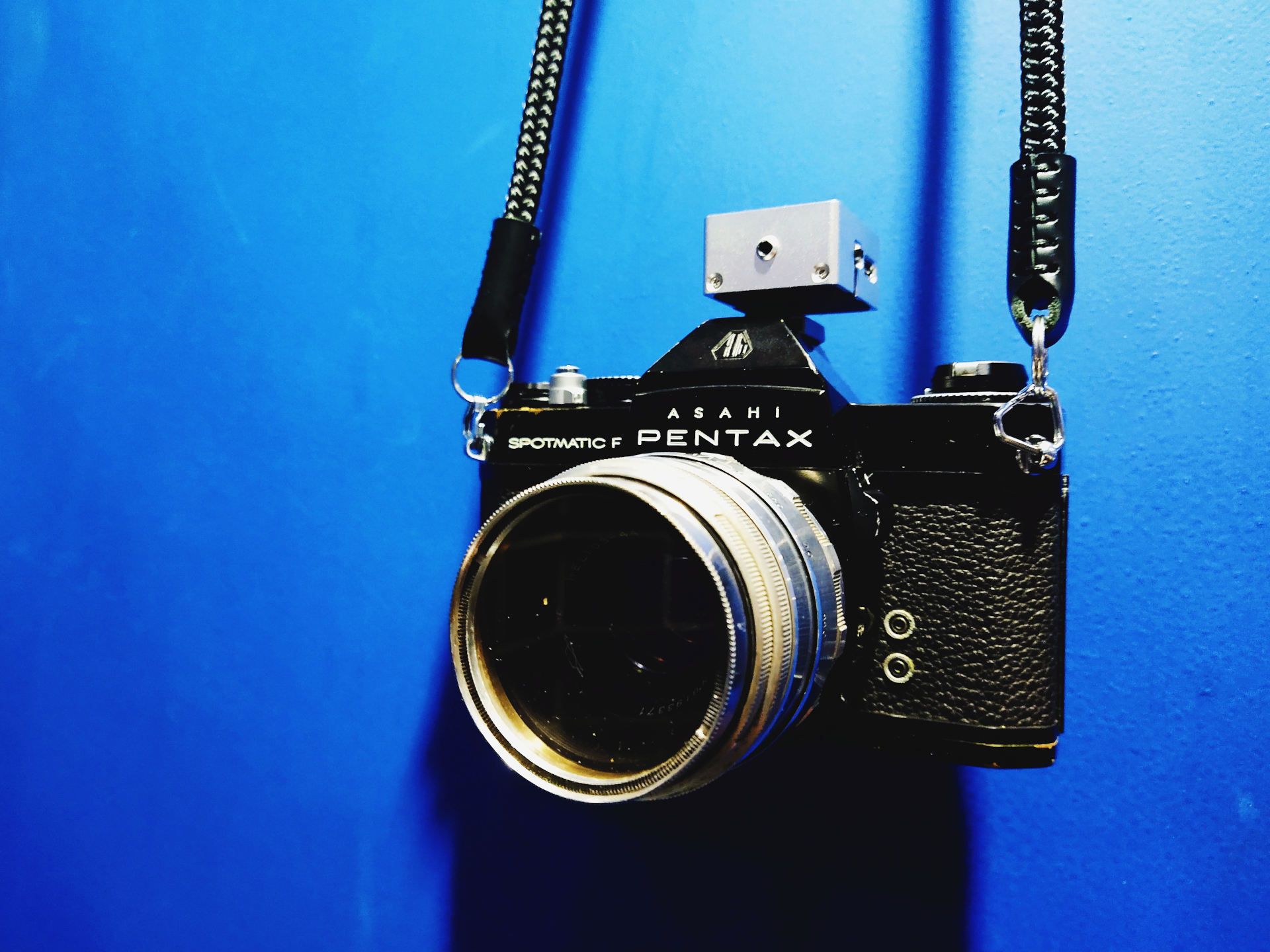
In terms of which body I prefer (and leaving aside the difference in colour), the SPF is clearly a much better camera, with its much improved features, but the SP500 isn’t to be sniffed at for the cost.
Cost and Availability
You can find a bunch of Spotmatic SLRs on eBay, and they can be as cheap as about £25… but they are usually a bit more if you want one in great condition. An SP500 will usually be substantially cheaper than an SPF, but if you aren’t bothered about the additional niceties like the self-timer, updated meter, built-in shoe mount or a shutter lock – they are a great option.
Sample Images
Below is a mixture of shots taken from both the Spotmatic F and the Spotmatic 500.