

This post looks at the Canon 50mm f0.95 and Canon 50mm f1.2 together. For a more recent post just looking at the Canon 50mm f0.95, take a look at this.
As long as I can remember, I’ve always been a bit of a creature of the night. Getting to stay up late was a treat, and in time I found that I loved the stillness that would come from feeling as if I was the only one left awake in the world. This developed into a general preference for the wee hours, and (almost) everything else associated
This penchant for dark places, combined with a love of drinking, and a curiousity for unusual camera gear, led to a natural interest in lenses with wide apertures. The lower the f-stop, the better.
The Canon 50mm f0.95 is something of a legend, dubbed the ‘dream lens’ by its fans. It was the fastest lens to be made commercially, though there have since been others produced that have matched it (such as the Leica Noctilux). People have described it as a ‘light hoover’, as it lets photographers shoot in extremely poorly lit places. I joke that mine can see in the dark.
Even though there are alternatives to the lens around now, none of them have quite managed to conjure up the same sort of mythical status as the Canon has. This is in part due to the fact that it was originally designed only to work on one particular rangefinder camera – the Canon 7 – but the real draw is the dreamy effect it has on the background when shot wide open. The extremely shallow depth of field all but obliterates the background, making it look something like a painting. When used well, this can enhance colours, smooth out skin, and suck the viewer deep into the eyes of the subject of the photograph. Used at night, tiny light sources become huge circular, glassy looking balls of bokeh.
A few years ago I managed to get a hold of a Canon 7, complete with the dream lens from eBay for a bargain price.
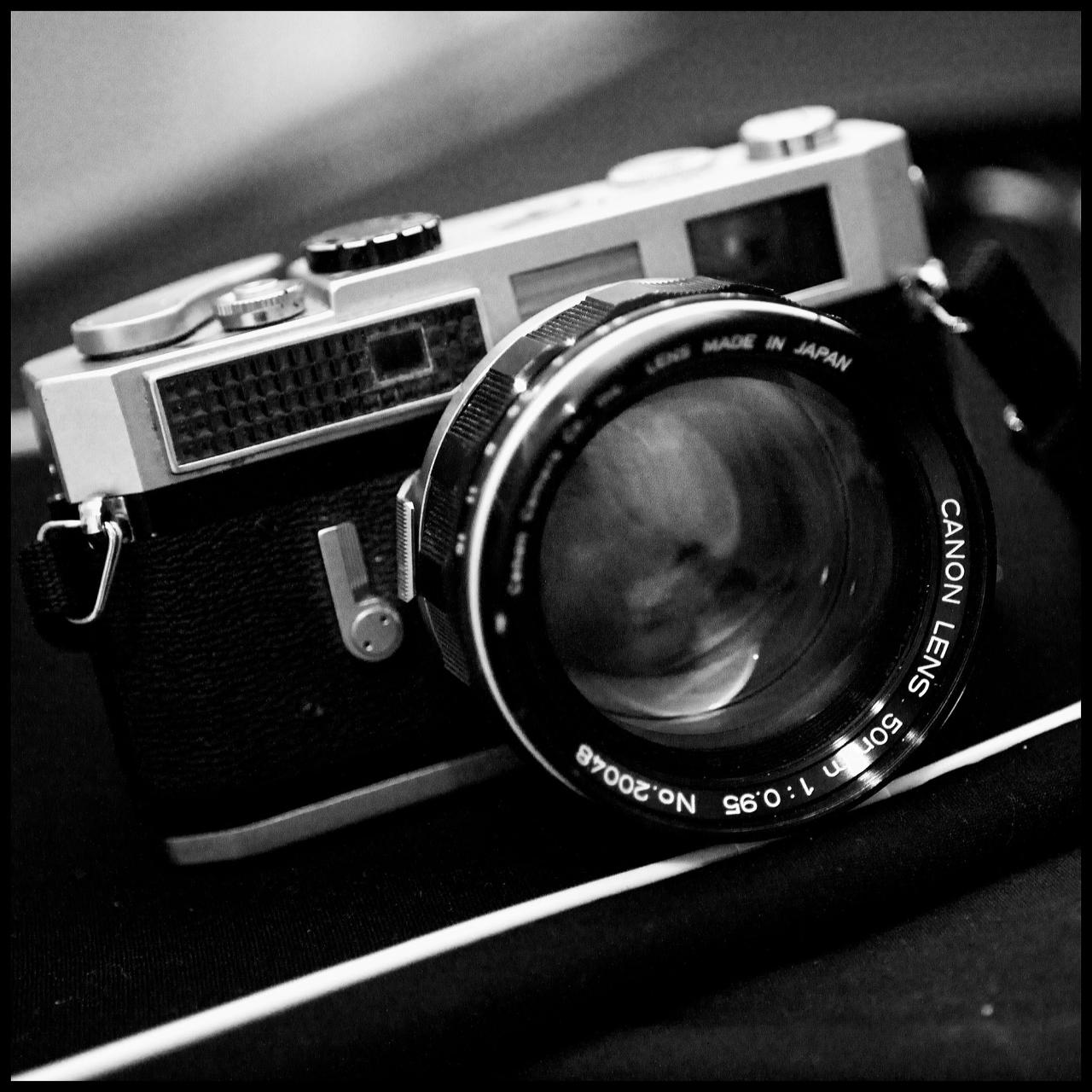
I loved some of the pictures it produced:



In general though, the quality was extremely hit or miss. I was lucky to get 1 or 2 good shots out of a roll of 36, which was just way too low a hit rate to make it worthwhile. The promise of what it was capable of turned out to be more attractive than the reality. It seemed like either I had a duff copy of the lens, or that the Canon rangefinder would have to be constantly calibrated to ensure that it would focus properly. After a few months of lost shots, I gave in and sold the whole package on eBay again. By the time it went to auction it went up to almost triple what I had got it for in the first place. The extra money helped pay for my first trip to the US, where I met the girl I’m now married to – so it was definitely a good move.
When I got my Leica M6, and then my digital Leica M8 bodies, I needed to find some fast 50mm glass to use with it, and so I found a Canon 50mm f1.2 lens in the M39/LTM mount – which can be easily used with an adaptor.
It turns out that the 50mm f1.2 is like the baby brother/sister of the 50mm f0.95 in lots of ways. The character of the lens, along with the bokeh it produces is pretty wonderful:




So wonderful, in fact, that I almost forgot about the Canon 50mm f0.95. However, I always thought that one day I might own another one of these special lenses, and so in a moment of madness recently I found one on eBay. This time, it had already been converted to use the Leica M mount. My rationale was that the lens would be a lot easier to use on a digital rangefinder, as I would be able to tell quickly if it was out of focus or not.

The results turned out better than I could have hoped:


It seems like I got lucky, and found a copy that has been converted well, as apparently there are some dodgy ones floating around, as the result of people doing the work without really knowing what they are doing. Either way, the properly calibrated Leica M bodies really help this lens sing.
There are criticisms that this lens isn’t very sharp wide open, which I don’t really understand. If you get the focal point right, then it’s more than sharp enough. Although, if all you’re interested is hyper sharp pictures, then re-engineering old technology to fit on newer bodies probably isn’t for you anyway.
The first thing that surprised me when the 50mm f0.95 arrived is the sheer size of it. I knew it was a large lens from the last one I had, but seeing it in comparison to the f1.2 was a bit of a surprise. It’s obscenely large, partially covering both the red Leica dot on both my M6 and M8. Perhaps even more amusing is that its diameter overlaps the lens release button, so to get it off of the body is a bit of a pain – requiring the corner of a credit card or something similar. I’ve found that one of the tools you get for removing sim cards from iPhones does the trick nicely.
It’s safe to say that the 50mm f0.95 on an M body blows the results from the Canon 7 out of the water. There are some purists who would rather see the lenses kept with their original mount, but to me that only reduces the amount that they can be used – a terrible shame.
Now, for some gratuitous gear comparison pictures:


