
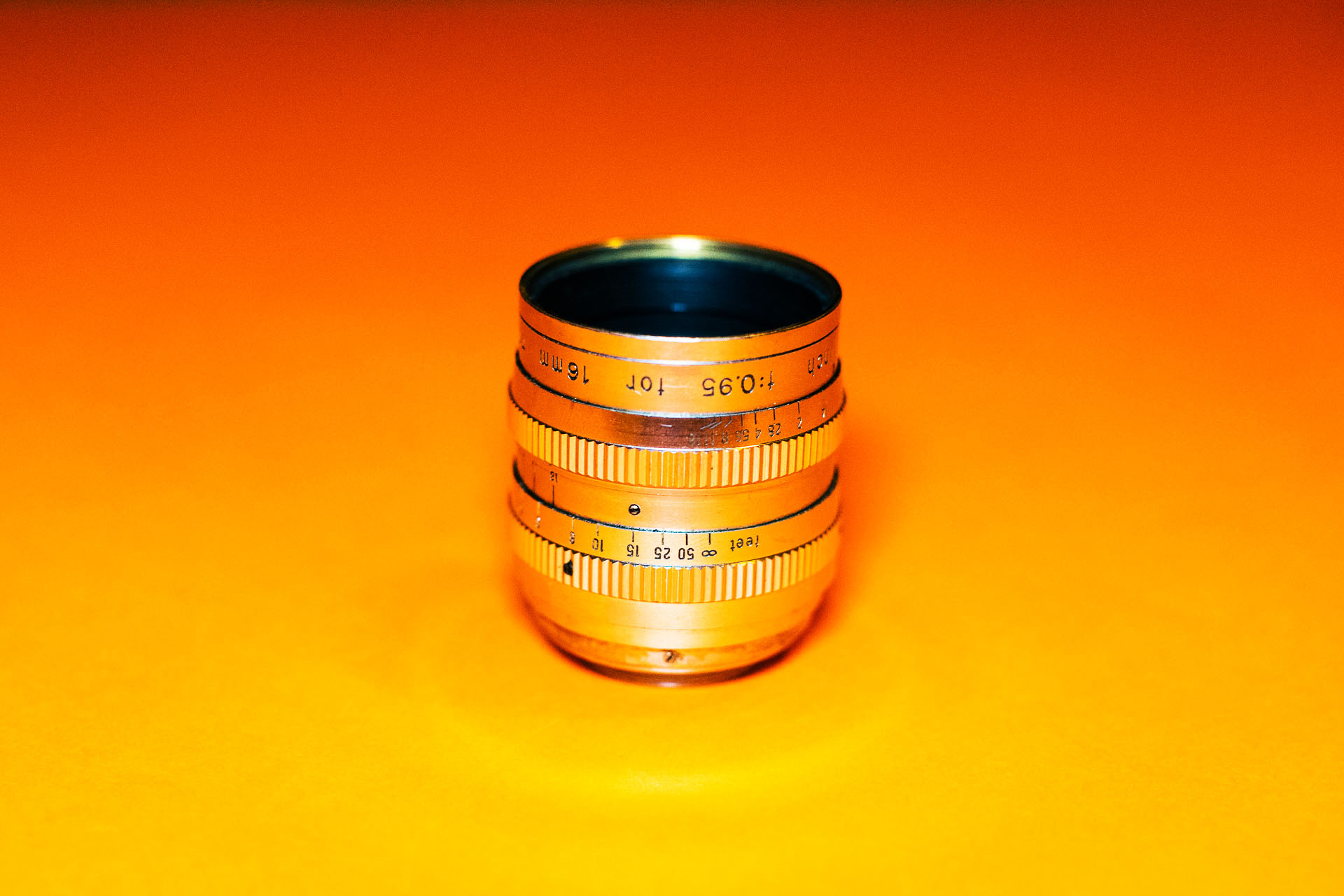
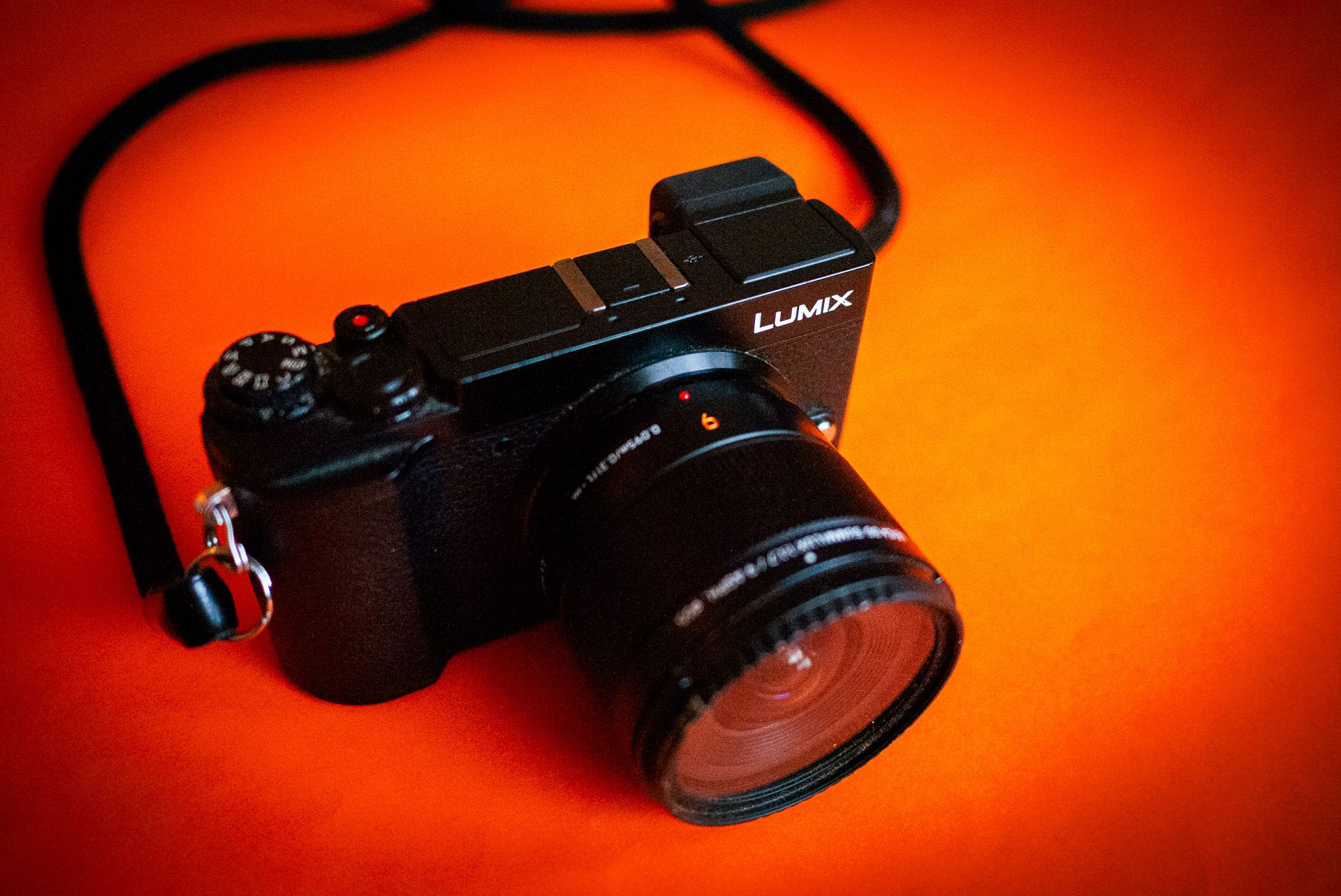
The Lumix GX9 is a 20 megapixel, Micro Four Thirds (MFT) digital camera from Panasonic. It was released in the Spring of 2018, and is part of a series of similar bodies, including the GX7, GX8, and GX80. I was inspired to pick one up after rediscovering one of my old favourite MFT cameras, the Lumix GF1. Sensor technology and functionality has moved on significantly since the days I was cutting about with that earlier model, and I was curious to see what use I could get out of my rather unusual Elitar Soligor 25mm f0.95 with something a bit more up to date.


Lens Choice
As well as playing about with weirdo manual focuses lenses, I wanted to have the option of shooting auto-focus as well. I mean, it’s 2025 after all. Once upon a time the range of lenses available for the M43 system was limited… or at least they were when I first bought my Lumix GF1. However, that has thankfully changed, and there are now a whole load of good ones out there at reasonable prices. I’ve personally opted for the Leica badged range – not really because I really expect them to be much better in terms of image quality or anything – but because they often offer the best focal length and aperture combinations. At least that’s my story, and you can’t prove otherwise.


Currently, my collection of modern, auto-focus MFT lenses includes the following:
- Leica 9mm f1.7 (18mm full frame equivalent).
- Leica 15mm f1.7 (30mm ff equiv).
- Leica 25mm f1.4 (50mm ff equiv).
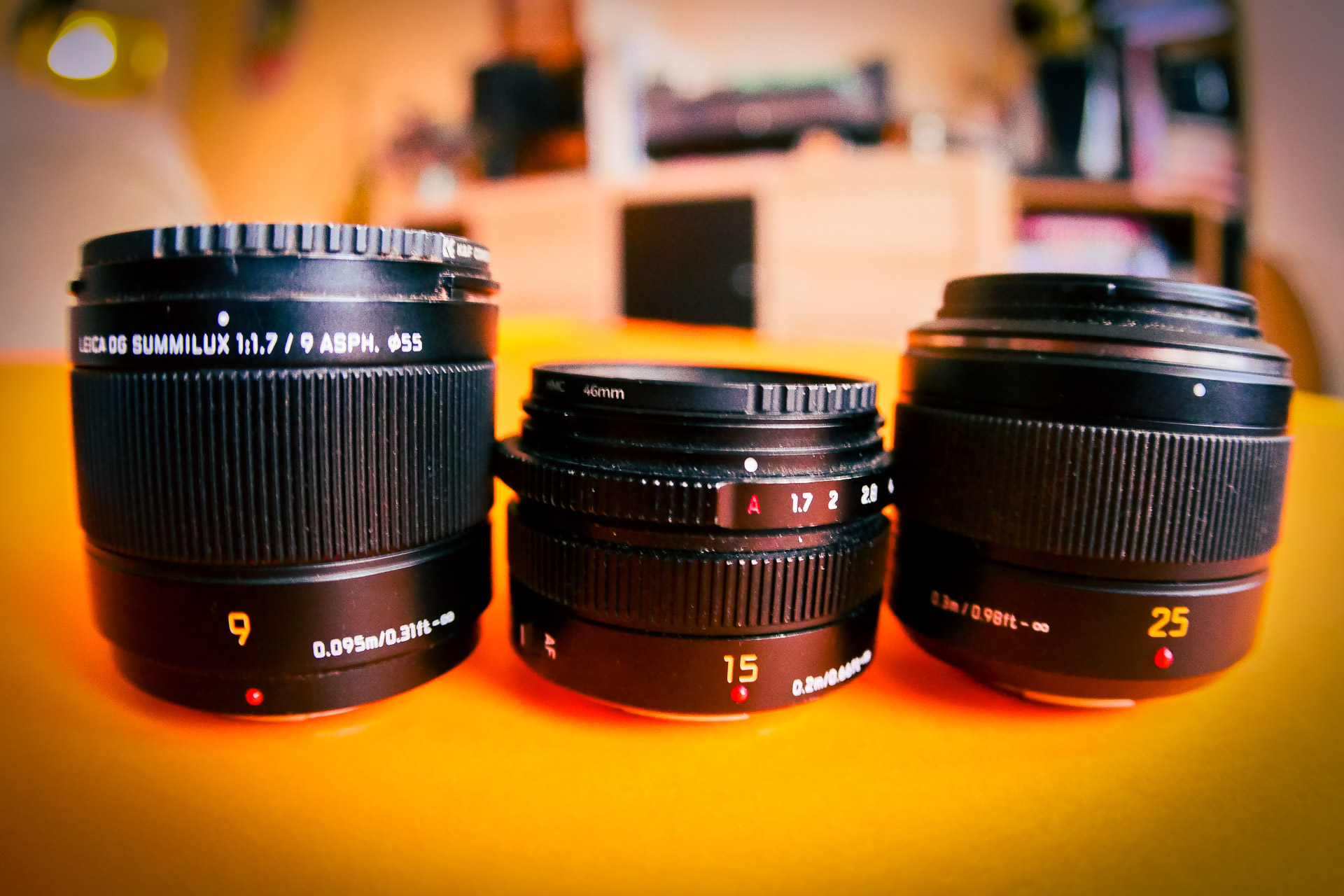
This selection covers quite a lot of (err, visual?) ground, and barely takes up any space in my camera bag. The 15mm in particular is teeny, and a brilliant all-rounder – though to be honest – I’ve found myself reaching for the 9mm most frequently. While it’s physically a bit bigger, it lets me get a lot more in the frame, and is great for close-quarters snapshots. Coupled with the wide aperture, it’s especially good for pubs. Places that I tend to find myself fairly often.


In the future I might pick up a 40mm lens (80mm equivalent), for those rare scenarios that I find myself at a gig while travelling, but it’s probably an unnecessary expenditure, especially since I’m the sort that over-packs cameras for trips anyway… and I haven’t really shot with the 25mm at all.


In addition to the ‘digital’ lenses, I also have the aforementioned 25mm f0.95 cine-mount thing, and a newer TTArtisan 7.5mm f2 fisheye. Both of these are manual focus, and to be honest the 7.5mm lens is pretty much redundant given how close in both aperture and focal length the Leica 9mm is – but selling it seems like a waste since I’ve only shot it at a handful of times.


Features
I won’t go into details about all of the technical specifications of the camera, because that’s something you can look up on a product page, and honestly, doing so would bore both you and me senseless. However, there are some specifics that I think are worth highlighting.

GX8 v. GX9 – For a while I was debating going with the older GX8, as it had some attributes that the GX9 did not. For example: A fully articulating screen (which is better for shooting video), a microphone input jack (also better for shooting video) and weather sealing (so I can take pictures in the rain). However, in the end the GX9 won out, as it seemed like the most suitable option for photography, which was really what I was going to be using it for most of the time.
Screen and Viewfinder – The screen of the GX9 in particular was designed to tilt rather than twist out and around – meaning that it acts kind of like a waist level finder. In practice this allows you to take pictures while looking down, rather than straight ahead; something that is invaluable for candid street photography (but again, less useful for video). There is an electronic view finder which physically swivels upwards in a similar fashion – kind of like a submarine periscope, though I don’t really understand the point. I generally dislike EVFs, and this one is no exception. Thankfully, you can disable this – something I did immediately. This created a rather strange situation in Munich airport, where the security demanded that I ‘turn it on’ so they could look through the finder, and were incredibly confused when they couldn’t – even more so when I tried to explain the concept.

Built In Flash – The presence or absence of a built-in flash is not something that would ever be a major consideration for me when purchasing a camera. Often, the results from these are pretty terrible, and I prefer available light anyway. However, the one fitted in the GX9 has actually proven to be useful in some situations, such as those times that I find myself inexplicably, spontaneously drawn to a nightclub and need that little bit of fill…

Discretion – Sometimes you want to avoid drawing attention to the fact that you are taking picures – whether that’s out and about on the street, or with a group of friends where the click of an actuation would feel intrusive. The GX9 already has a fairly quiet mechanical shutter, but you can easily switch to a completely silent electronic shutter with the click of a button. Similarly, the rear display can be completely turned off, so that it isn’t necessarily obvious to passers by that the camera is on. Both of these are subtle, but welcome touches.

Performance
Low Light – The GX9 performs reasonably well in low light – which is often where I find myself skulking about. However, there is quite a bit of noise at higher ISOs. That should have been pretty obvious – given the sensor size – but it still caught me by surprise. To mitigate this, I would avoid going over ISO 3200 unless there was no way to get the shot otherwise (capping Auto ISO similarly). In circumstances where I needed to clean things up a bit for individual shots, I found Topaz Photo AI was useful when applied judiciously. However, I found that even with significant tweaking, I often ended up preferring the original images. So it’s kind of hit or miss.


Video – While I didn’t buy the GX9 to shoot video specifically, I do like to capture snippets of everyday life from time-to-time, and so having some kind of decent video functionality is important. While there isn’t any LOG options to speak of, I was pleased to find that the quality of the footage was good, and the stabilisation surprisingly smooth. Panasonic stab best in the business so I hear…
Colours – I don’t really know enough about colour science to talk about that with any kind of authority. However, I have shot with a lot of different cameras, and can speak to my own perception of how colours well, look. Generally, the GX9 has decent enough colour reproduction, but they aren’t the most vivid in the world. If I compare the output to the much older Leica M 240, there’s no real contest. However, that shouldn’t be a massive surprise, given the difference in sensor size. In practice, the colours are usually fine, but I often find myself converting pictures to black and white, as it looks far better, more consistently.


Focus – Face detection is included with the GX9, and it has generally been pretty spot on. For situations where you want to be more specific with auto-focus, the touch screen is useful, though I found that it would often trigger accidentally when I had the camera slung over my shoulder, so usually kept it switched off. That was a pain for those rare occasions when I actually wanted it to work… but I still have to figure out if I can assign it to a button. Or if I want to use up valuable finger estate with such a thing.


Oh, while we’re on the topic of focus… something that I am constantly amazed by is just how close you can get to your subject. I am sure this is completely unremarkable to most folks, but as a regular rangefinder shooter that is used to minimum distances of around 0.9m, this is a real treat.

Exposure metering – One weird thing that I’ve noticed is that the GX9 doesn’t update the preview image displayed on the screen as you adjust the exposure. Rather, it maintains that at a constant. In other words: What you are seeing doesn’t correlate to the resultant image. That means that you need to pay close attention to the exposure meter readout in the bottom right in manual mode – something that isn’t the case on many of the other cameras that I’ve got. I’m not sure exactly why this is the case with these Lumix models, but it’s a bit of a mindset shift, and one that I regularly forget.
My Experience
For a long time, the one camera that I took everywhere was the Ricoh GR III. It was tiny, unremarkable looking, but very capable. It was particularly great for candid street and travel shots, but also somehow managed to perform admirably in dingy pub basements. I literally used it to the point of destruction, and couldn’t really afford to replace it. However, the GX9 has rather unexpectedly filled the gap that it left behind, to the extent that I don’t even really miss the GR at all. While the GR was undeniably a much smaller package, the GX9 has many of the main features that I liked from the Ricoh, and also provides much more in the way of flexibility, thanks to its interchangeable lenses.

In practice, I find myself using the GX9 heavily. It is portable enough to be chucked in a bag, and versatile enough to be thrown into a variety of different circumstances. It has helped me capture and preserve moments with friends, important trips abroad, and even special occasions like my cousin’s wedding. It has become my standard go-to for all sorts of situations.






Whilst not really the usual topic of this blog, the GX9 has also proven to be pretty capable for quick and dirty videos. Yes, it doesn’t have a fully articulating screen, and there isn’t a mic input… but as mentioned above, the built-in stabilisation is pretty great, and I sometimes actually end up choosing this over the Sony bodies that I have for sheer convenience sake, even though the Sonys should in theory be much more capable.
Overall I am pretty pleased with the GX9. It certainly isn’t the best quality or most character-filled camera in the world – and if I have the luxury of taking multiple camera bodies on a trip I will usually accompany it with something like the Leica M – but as a general all-rounder that encourages me to take pictures regularly, it fits the bill perfectly. More often than not, it comes with me in my bag.
As something of a photographic celebrity (lol), I am often asked for recommendations on digital cameras that are portable, but also powerful… ones which give you lots of manual controls and the ability to change lenses… but which also won’t take up much room, and can be flipped to auto if need be. If that’s the kind of thing you’re after, then you’ve stumbled upon the right article.
Photies
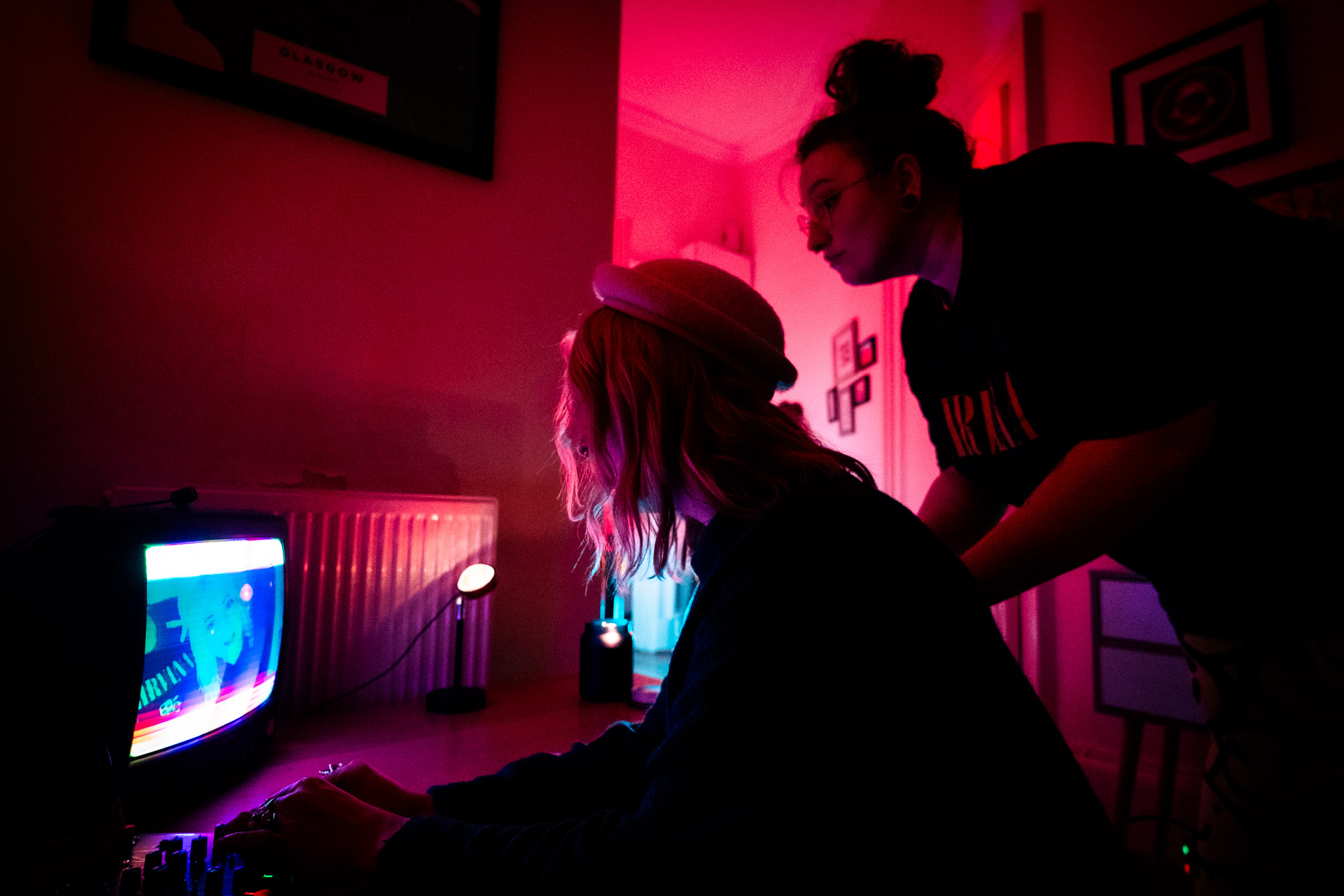
Below is an ever-evolving collection of pictures that I’ve taken with the Lumix GX9.





























Last updated: